Pages

Tuesday, May 29, 2012

Growing Borage for Happiness


Borage has long been celebrated as a simple tonic for happines and courage. Their petite, yet beautiful blue flowers are a reminder that joy is found in the most minute details of life. Borage is excessively simple to grow and will spread happiness wherever you let it.

Uses:
Traditionally, borage flowers were added to wine to "drive away all sadness, dullness and melancholy." They were also candied or made into syrup for this same purpose. The young leaves have a sight cucumber taste and can be added to salads, although their hairy teture can take some getting used to. The herb itself is said to be a mild anti-inflammatory and diuretic. It is often used externally to treat inflamed skin, or as a mouthwash or gargle. There is some evidence that suggest Borage may contain an alkaloid that can cause liver damage, so it is probably best to avoid prolonged use. I'm a big fan of homebrew soda-making, and borage flowers are as necessary as a slice of lemon in my ginger ale.
Borage is grown commercially primarily for Borage Seed Oil, a hormone-rich substitute for evening primrose oil. This makes a wonderful additive to skin creams and moisturizers. I use borage seed oil in place of rose hip seed oil in this acne-clearing moisturizer.

How to Grow Borage:

A strong self-seeder, make sure and pick a spot in your garden where you don't mind borage expanding. This herb tolerates any kind of soil, although it will be happier if you plant in moist, rich earth. Borage loves a sunny spot, but will still bloom in a partial shade.
Borage dominated this plastic bin herb garden I planted last year.
Borage grown readily from seed, which can be planted in the spring or fall. Cover seeds in about 1/2" of soil. Borage will appreciate you waiting until a few weeks after the last frost.
Your seeds will germinate in 7-10 days. Borage is very hardy and doesn't need much tending. Mine is occasionally attacked by slugs, but a cedarwood spray has been effective at stopping them so far.

Monday, May 28, 2012

Savvy Tips, Demystifying Herbal Salves Part 2: Liquid to Solid

This week we'll be dealing with the herbal alchemy of transforming a liquid oil infusion into a solid salve. Be sure to check out last weeks blog about oil infusions if you haven't done so already. Every good salve must start with a good oil infusion.
The main thing to keep in mind when making a salve is preservation and cleanliness. When made and stored properly, salves have a shelf life of 2-3 years. The last thing you want is all those precious ingredients go to waste because of contamination from dirt, water or other kitchen hazards. The most common trouble maker is water, so be sure to thoroughly dry all containers before transferring your oil infusion into them.

What You'll Need:
  • Wax: Beeswax is my favorite, but you can use vegan alternatives like candelilla if you'd prefer. A general rule is for each cup of oil add 1oz (weighed) wax. I'd highly recommend getting a scale, or you can buy wax in 1oz chunks. You may want to adjust this depending on climate and personal preference. I typically use 1.1oz wax for each cup of oil. Wax can be found in bricks or pellets. Bricks can be broken apart with a (clean) flat-head screwdriver and a rubber mallet.
  • Vitamin E: This will not only help extend the shelf life of your salve, but it's also wonderful for the skin. Try to find pure Vitamin E (read the label, as most are diluted in veggie oil for consumption). I use Jason's Vitamin E at 32,000 iu. Add just a few drops to your batch. If you can't find straight Vitamin E, try to get Vitamin E capsules. Pop a few open and squeeze the thick Vitamin E into your salve just before pouring into your jars.
  • Precious Oils: Rose Hip Seed, Borage Seed, Evening Primrose, Meadowfoam and Hemp Seed oils are just a few of the many nutrient-rich oils you can use to boost your formula. I like to add these oils at the end of the salve making process, just before pouring into the jars. This lessens the nutrient loss due to heat exposure. I typically add 1-2 TBsp of precious oils to each cup of base oil.
  • Essential Oils: The possibilities are endless here. Favorites include Lavender and Tea Tree for healing salves, or Peppermint and Ginger for a muscle rub. I add my essential oils to the empty jars my hot salve will be poured in. Heat vaporizes the essential oils and weakens the scent and healing properties. I use 20-30 drops of essential oils for each ounce of salve.
  • Double Boiler: You will need a double boiler to make your salve. Don't ever put your oil or salve over direct heat. You can make a simple double boiler by finding two pans, one bigger and one smaller so that they can nest. Then, just throw a wide mouth canning jar ring into the bottom of the bigger pan, add a little bit of water and set your smaller pan right on top of the ring with the handle hanging off the side of the bigger pan (for stability). Voila! Instant double-boiler. 
  • Jars or Tins 
  • Chopsticks, Spoons 

Making The Salve

Step 1: Strain and Press
Strain your salve directly into your salve making vessel (the upper part of your double boiler). Strain the herbs out of your oil infusion using a muslin bag or clean bandana. Pour slowly and don't let any plant matter get past your fabric. It's normal for minute particles to accumulate at the bottom of your salve. Squeeze the leftover plant material as hard as you can to extract all of your herbs' properties.

Step 2: Heat and Melt

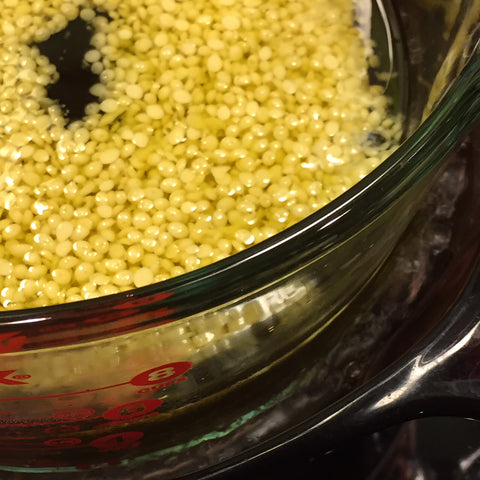
Add your preferred wax to your strained oil infusion and place in your double boiler. Start with 1oz wax for each cup of oil. If you're using glass, make sure it's heat resistant and always heat slowly. Your double boiler should be on medium-low heat. Watch it carefully so the water doesn't boil or splash into your salve. Should a little water accidentally get into your salve, carefully spoon it out. Stir your salve occasionally to help it melt.
While your salve is melting, prepare your empty jars or tins to pour your salve into. Add your essential oils to the bottom and keep a chopstick handy.
Once the wax is completely melted, spoon out a small amount and place it in the freezer to harden. Test your salve to make sure it's thick enough. If it's to hard, you can always add a little oil to your mix. IT'S VERY IMPORTANT TO TEST YOUR SALVE. There's nothing worse than having to melt down salve that's already been poured into jars.

Step 3: Make Pretty and Pour

If you're improving your salve with precious oils or Vitamin E, turn off your stove and add them now. Mix thoroughly. A few tablespoons of precious oils wont dramatically effect the consistency of your salve, but you can test it once more if you'd like. Carefully pour your salve into your prepared containers. Start with the bigger jars and end with the smaller ones. It's much easier to pour small amounts of salve when there is less of it to handle. If you added essential oils to your salve jars, use the chop stick to mix everything while the salve is still hot.

Step 4: Clean and Store
It's easiest to clean up salve while it's hot. Dump boiling water over everything that has salve on it. Then wash with very hot soapy water. When your salves are completely cool and hard, cap tightly and store in a cool, dark place.

Thursday, May 10, 2012

Savvy Tips for Herbal Salve Making Part 1: The Oil Infusion


Natural salve and balm recipes can seem rather straight-forward, but liquid-to-solid alchemy can play tricks on us. Some lessons are only learned with time and wasted ingredients, so here I'll share with you my successes and failures spanning my six years of salve making.
First, lets start with the oil infusion. This is what you will use to make your salve by adding beeswax and essential oils (more on that next week). A good salve must start with a good oil infusion!


The Oil Infusion
Every salve recipe I have found recommends olive oil, which is readily available and not a bad choice. But, there is so much more out there in terms of skin-loving oils! To be honest, I hate olive oil salves. They're greasy, they don't absorb well and my infused oils end up smelling like something I'd throw on a salad. Not to deter experimentation, but if you have one of the following oils available, your skin will thank you:
  • Coconut: It's becoming much more widely available. Just get the cheap stuff, doesn't need to be virgin/raw because you'll be heating it to make your salve anyway. I've actually found it's more affordable than olive oil in most cases. Coconut is my new favorite. It's totally non-greasy and odorless (or light coconut smell if you get the less processed stuff). Coconut Oil is solid at room temperature, so it's recommended that you use the stovetop method for making your oil infusion (or use in combination with another oil so that it stays in a liquid state while infusing)
  • Sweet Almond: It's not as widely used in cooking, so it can be a bit harder to find. Also absorbs like magic and relatively odorless. Not an option for those with nut allergies.
  • Apricot Kernel: Very similar to Sweet Almond and generally well tolerated by allergy sufferers.
  • Grapeseed Oil: Great for sensitive skin and hair follicles. Slightly astringent, this is a pefect choice for acne-prone skin. Absorbs well, slight nutty odor.
  • Jojoba: Also great, but should only make up about 10% of your blend. Its a bit thicker than the above oils and can irritate some individual's skin when used full strength.
No doubt there are other wonderful oils out there, but these are my personal favorites and generally easy to find. If you can use just one of these oils in combination with Olive, it will greatly improve the consistency of your salve. Even just 25% of one of the above oils in combination with olive will make a big difference. Otherwise, ratios are up to you!
Once you have your oil choices figured out, you need to decide on herbs. The possibilities are endless here, so don't hesitate to scour some resources and get creative! Here's some commonly used herbs:
  • Calendula: Anti-microbial, soothes irritation. Powerful, yet gentle healer.
  • Yarrow: Traditionally used to stop bleeding and heal all kinds of wounds and abrasions.
  • Comfrey: A powerful healer, but not recommended for open wounds. It can heal the outer skin too quickly, trapping bacteria and potentially infection underneath. Great for cuts and scrapes that have already scabbed over.
  • Rose, Lavender and Chamomile: All wonderful skin soothers that impart a lovely scent to your salve.
  • Gotu Kola: This is my secret weapon. Does wonders for dry or infected skin. Increases circulation and is even known to reduce varicose veins. Most of all, this herb is invaluable for anyone with thin or aging skin. It's known to help thicken and toughen delicate skin.
It's very important that your herbs be thoroughly dried before making an oil infusion. Salves and oils have a shelf life of 2-3 years if made and stored properly, but any moisture added to the mix can cause an oil to quickly go rancid. If you collect your herbs fresh you'll want to dry them by using a dehydrator, low heat (150 degrees) oven, hang in bunches or spread onto old window screens to let dry in the shade.

Oil Infusion Recipe:
When experimenting, there's no need to make a large batch of oil. Start with one cup, or even 1/2 cup:
You will need:
  • 1 Cup Oil
  • 1/2 Cup Dry Herbs
This is just a general guideline, the amount of herbs to oil is entirely up to you. Sometimes less is more!
       
Once you have your herbs picked out, you'll want to grind them up as fine as possible to aid in the extraction of the herb's healing properties. You needn't go crazy here, but if you have a blender or coffee grinder on hand this makes it super easy. Use the pulse setting on your blended to chop everything up. I love the coffee grinder as it's easy to powder roots if I need to. Alternatively, a mortar and pestle or your bare hands work fine too.
Pack your container half full of herbs and cover them in oil. Make sure your herbs are immersed in oil. The more herbs you use, the less oil you'll end up with (due to absorption). So, if you're looking for exactly 1 cup of infused oil, add a little extra oil to the jar to compensate for loss.
There's two ways to make an oil infusion:
1. Solar: Find a clear glass jar large enough to hold your herbs and oil. Mix well, cap tightly and set in the sun for 1-2 weeks. Shake at least once a day.
2. Oven/Stovetop/Woodstove: If you're in a less-than-sunny location, or if you're short on time you can still make a great oil infusion! The oven is easiest. I set mine on 150-170 degrees, put everything in a pyrex measuring cup and let it cook for 4-5 hours, stirring occasionally. You can also cook over a double-boiler on the stovetop, although this requires a lot more attention. Be careful not to splash water into your oil infusion. Never put an oil infusion over direct heat! You'll end up with deep-fried herbs and a nasty smelling oil.
Check back next week for tips and instructions on turning that lovely new oil infusion into a silky-smooth salve!


Wednesday, May 2, 2012

Lemon Balm Recipes

Lemon Balm leaves can be harvested as needed, so whether you have an established patch or just planted yours yesterday, you'll soon be enjoying those fragrant lemoney leaves. Here's a few of my favorite (and never-shared-before) recipes.
Calm and Cozy Tea
I blended this tea with two goals in mind. First, I wanted a tea that would act as a mild relaxant but not a sedative. A relaxant can be used to ease tension at any time of day, and is very safe for both children and the elderly. Sedatives, on the other hand, have a wide range of effects on people (some folks are even stimulated by certain sedative herbs like Valerian) and often cause drowsiness. I'm not into selling miracle cures, but would rather help people incorporate herbs and aromatherapy into their daily routine, if only for pure enjoyment. In short, I don't advocate the use of strong herbs without proper guidance.
Moreover, I wanted a gentle tea that would help settle my tummy should I happen to eat something that was not so easy to digest (I've mostly cut grain out of my diet, so when I indulge it can cause some serious stomache acidity). Calm and Cozy is what I concocted:
Ingredients:
  • 1 Cup Peppermint Leaves
  • 1/2 Cup Lemon Balm Leaves
  • 1/4 Cup Fennel Seed
  • 1/4 Cup Cinnamon Bark (chunks, not powder)
  • 2 TBSP Ginger Root
If making a single cup, feel free to use fresh herbs. For this batch, all herbs should be dry for storage. You can use cinnamon powder instead of chunks, but be warned that if you don't contain it in a muslin bag during steeping, it will turn into slime. Thoroughly mix all ingredients and store in an airtight container.
For tea, use 1-2 tsp dry herbs for each 8oz cup of tea. Allow to steep for 10 minutes, strain and enjoy!

Sweet Meadow Smoke Blend
Sweet Meadow Smoke Blend is always popular at Wild Rose
I've never been a smoker, but I have had several friends ask me to help them quit with herbal teas. In addition to tea, I came up with this sweet herb blend to help satisfy the urge to smoke. Surprisingly, I really enjoy smoking this blend on occasion. It's tasty and slightly euphoric, the perfect addition to a warm night.
Ingredients
  • 1/2 Cup Lemon Balm Leaves
  • 1/2 Cup Red Clover Blossoms
  • 1/2 Cup Chamomile Flowers
  • 1/4 Cup Damiana Leaves
  • Pinch of Pineapple Sage (or Sage of choice)
All herbs must be very dry. Put everything in a blender and use the ice crush mode to slowly grind the herbs. The mix should become slightly fluffy, but not super fine. Just enough to make rolling it easier. Store any extra herbs in an airtight container.
The Lemon Balm massacred by my neighbor is doing much better now. I should be picking my first leaves in a few short weeks!

Wednesday, April 25, 2012

Grow Lemon Balm from Seed or Root Clump

Lemon Balm can - and will - grow anywhere.

I have limited growing space in my current location, but I simply cannot imagine a Summer without Lemon Balm. This is another herb so tasty and easy to grow that there is really no reason to exclude it from your gardening plans.

Lemon Balm for You:
A mild sedative, Lemon Balm is invaluable for the restless mind, especially for children and the elderly (Lemon Balm tea does wonders for anxious Alzheimer'spatients). However this effect is very gentle, and Lemon Balm can be enjoyed any time of day. A known antiviral and tummy tonic, this herb is an ideal cold and flu treatment. Lemon Balm makes a wonderful sun tea, smoke additive and herbal bath. One sniff of this herb and you'll want to try it in everything!

Lemon Balm for Your Garden:
Lemon Balm was once considered a sacred plant due to it's abilities to attract bees. This makes it a wonderful addition to a garden bed, particularly with tomatoes. Its aromatic nature is also said to deter pests, including mosquitoes. One thing to be aware of is that Lemon Balm, like other plants in the mint family, are quite hardy and will spread wherever they can. If you live near a wild place, you may want to grow your Lemon Balm in a container so that it doesn't overgrow native vegetation (I've come across huge patches of Lemon Balm in the middle of the woods). However, if you live in the city like me, the only thing Lemon Balm has to compete with is lawns. Personally, I'd rather have more Lemon Balm!

How to Grow Lemon Balm:

My mow-happy neighbor dessimated the Lemon Balm patch growing in the the vacant lot next door. Good thing Lemon Balm is persistant, these chopped up patches are being moved to my yard!

Step 1: Pick a Spot
Containers suggested for wild spaces. City folks, plant it everywhere! There's nothing that brings me more joy than walking down a city sidewalk and brushing up against an overgrown patch of Lemon Balm. Most people don't notice they have such a useful plant taking over their yard. Like most herbs, Lemon Balm is not picky. It loves sun, but will also thrive in shade. It's best to wait a few weeks after your last frost to plant Lemon Balm. It will come back every year, so a fall planting is also appropriate.
The lawn had overgrown a planting area near my front patio, so I took a shovel to the grass and loosened it up about 6" deep. I also put down a 2" layer of topsoil.

Step 2: Soil/Container Prep
Loosen your dirt a bit and/or throw down a 2" thick layer of topsoil. Container gardeners, a 5 gallon bucket will give you a big and beautiful plant, but don't hesitate to give it a try in any pot you have around. I once had Lemon Balm growing on a windowsill in a 1/2 gallon planter.
Tiny Lemon Balm seeds.
A root clump salvaged from the massacre site.

Step 3: Plant it!
Lemon Balm can be grown from seed, but it grows very quickly from root clumps. If you spot some feral Lemon Balm growing in your neighborhood, you can dig up a clump and start a patch in your own yard (Lemon Balm is frequently found in vacant lots, but be sure that you aren't digging up a cared-for patch). For seed starters, I prefer either a local seed company or Botanical Interests, not only because they have high sustainability standards, but their packages are both informative and beautiful! Lemon Balm, like other mints, have super tiny seeds that are simply pressed into the surface of your loosened dirt. Gently water your seed bed, being careful not to scatter those little seeds.
Much better!

Step 4: Take Care
Seeds germinate in 10-15 days. They can be thinned to 12" apart when 1" tall, but it's not neccesary. Root clumps should take off quickly. Use the leaves as needed. Lemon Balm can be severely cut back and will happily return. When I find a large patch of feral Lemon Balm, I cut back whole stalks (3'-4' tall) and hang it upside down in big bunches to dry. If it's still early in the season, they'll grow right back!

Since Lemon Balm leaves can be picked as needed, next week I'll share some of my favorite Lemon Balm recipes, like my Sweet Meadow Smoke Blend:


Wednesday, April 18, 2012

Growing Calendula for You and Your Garden

If you're looking to add herbs to your garden and your pantry, Calendula is a must. Not only is it ridiculously easy to grow, it also has an array of benefits for yourself and your garden. Both Calendula officinalis (Pot Marigold) and Tagetes erecta (Mexican or Aztec Marigold) have similar traditional uses.

Calendula for You:
Heals and soothes just about any skin abrasion, rash, cut, burn, infection or cosmetic problem like varicose veins. Internally, Calendula tea or tincture treats cuts inside the mouth, sore throats and even stomach ulcers! The petals look beautiful tossed with salad greens. Calendula is a known antiviral, antifungal and antibacterial herb. It's definitely in my top ten favorite herbs because it is so gentle, yet so effective. Calendula is an invaluable aid for keeping your skin healthy.
My Intensive Care Healing Salve draws part of it's power from Calendula-infused oil (recipe will be shared in a future Calendula harvest post).

Calendula for Your Garden:
Pot Marigold is a classic companion plant. Its scent will drive away pests, including Mexican Bean Beatles, Aphids, Tomato Hornworms and other nasties. Calendula helps everything, really, so don't hesitate to throw it around the garden. Tagetes erecta is known to protect plants from nematodes specifically.

How to Grow Calendula

Step 1: Pick a Spot
I chose a spot near my front door where the grass was overgrown.
Calendula is a prolific self-seeding annual growing from 1'- 3' tall. It's not picky (tolerates poor soil) and grows easily in partial shade, full sun, even patio pots (container gardeners, listen up!).
It can be planted pretty early in Spring, depending on where you live. Ideal germination temp is 59 - 68 degrees (F). They wont survive a hard frost, but are easy to cover when young. Calendula transplants well, so if in doubt you can always start yours indoors. I probably could have planted mine earlier here in Southern Oregon, but with the first blooms arriving in 40 to 50 days, there's really no need to stress.
Step 2: Soil/Container Prep
You don't need to do much to make Calendula happy. Loosen up the soil (6"-12" if you can) by jamming your shovel in the Earth and tilting it up just a bit. I like to get dirty, so I usually end up sifting through all the dirt by hand. Break up any clumps and remove rocks. If your soil texture isn't ideal, you can mix in some store-bought topsoil. The more work you do here the better for your plants, but Calendula will forgive your laziness. Set aside some sifted soil, enough to cover your planting area 1/4" deep.
Container gardeners will want to line the bottom of the pots with some small rocks or gravel for drainage. If you give Calendula a nice big 5 gallon bucket, she'll reward you with lots of blooms. But any container will do, really. If the plant looks crowded as it grows, transplant!
Soil sifted and ready to wet. I set the grass aside to die, I'll use it as mulch later on.
Step 3: Plant it!
Once your soil is sifted and smooth, thoroughly wet the entire area. Then, sprinkle your Calendula seeds across the top and cover with the sifted soil you set aside. Calendula needs a 1/4" covering, just enough to keep dark. Gently pat down your dirt and moisten your top layer with a spray bottle or watering can. Try to avoid traumatic watering as this will uncover your seeds and they may not sprout.
Step 4: Take Care
Seeds germinate in about ten days. I'm more of a hap-hazard gardener, throwing several herbs together in a patch and "letting the seeds fall where they may." I like my gardens to resemble wild spaces, with a mish-mash of edibles, medicinals and pretty things all growing together. If you'd like more order in your garden, feel free to remove any weeds and when your plants are 2" tall, thin so that there is 6"-12" between each plant. You'll be enjoying your first blooms in just 40-50 days!
I mixed my Calendula with Yarrow, Borage and a beneficial bee flower blend.
Calendula is the perfect herb for beginners and children, but it's also a staple among veteran gardeners as well. It's hard to go wrong with this beautiful and useful flower, so throw all caution (and seeds) to the wind. Check back here soon because before your plants are blooming, we'll have a harvest post complete with recipes for classic Calendula.


Wednesday, April 11, 2012

Container Gardening Cheap and Simple


A huge heriloom tomoato from one of my plants grown in a 5-gallon bucket!
I dream of having the perfect garden.Stone paths, ponds and raised beds all overgrown with medicinal herbs, edible perennials and tasty annuals. My future garden will look like it's been there for years, arguably forever, in a  cyclical state of decay and renewal. I'll know it like the back of my hand, probably because my hands will be forever buried in dirt and mulch until my garden is just what I want it to be.
But I'm not there yet. I've spent the past two years working hard and saving to buy my first house (and garden space). I love gardening so much, I couldn't let the limitations imposed by city living and landlords stop me from having fresh tomatoes and herbs. The house I was renting had a small enclosed deck, perfect for a mish-mash of veggies and flowers. Here I gardened for two Summers. Here's how I did it cheap and simple:

My first-year container garden (Dog shown for scale).
The first hurdle in container gardeningis finding affordable containers. Ceramic planters are expensive, heavy and breakable, a less-than-ideal combination. Wood is a great choice if you'll be in one spot for a while, but plastic is easiest and most affordable. There's no need to pay for overpriced plastic planters if you aren't worried about looks. Five gallon buckets are perfect for tomatoes and peppers of all kinds. I got mine brand new for $3 each. Plus they have a built-in handle! For drainage, I heated up a butter knife over a candle and cut little squares along the bottom and lower sides. If you have a drill handy, you can also drill a bunch of drainage holes. Drainage is a must for container plants, so make sure there are plenty of holes on the bottom of your pots. For bigger plants like squash and mini herb gardens I picked up some round 20-gallon tubs for $6 each. These have nice rope handles on either side for dragging your plants around. Another option is plastic storage bins. You can often find these for a couple dollars at thrift stores (especially when they're missing the lids!).

Drainage holes cut with a hot butter knife.
Next, you need to find a good spot to keep your plants. Most veggies need full sun, at least 6 hours a day. Depending on your bioregion, you may need to protect your plants from the cold or heat to extend your season (which is easier when you can move your veggies around). If you have a shady patio, choose plants that prefer less sun. If you want to start plants indoors, choose a sunny south-facing window. The nice thing about container gardeningis it doesn't require a whole lot of time or planning, so feel free to experiment. Even if you don't get many veggies you'll at least have another house or patio plant.

This is what I moved from my old house. Mostly herbs and Green Onions!
Here's a quick list of easy-to-grow container veggies:
Peas
Radishes
Lettuce
Kale
Carrots
Tomatoes
Cucumbers
Eggplant
Green Onions
Summer Squash and Zucchini
It's super important to fertilize your potted plants regularly since their roots only have access to the dirt they're sitting in. My preferred method is making "compost tea" in an empty milk jug. Simply put a couple handfuls of fertilizer/manure in your jug, add water and set it in the sun for one day. Use this just like any liquid fertilizer.
And don't stop at veggies! Herbs are a wonderfully low-stress way to learn about gardening. Most are prolific and don't need to fruit before using them. Many herbs can be grown in small containers near a sunny kitchen window. I even took on growing Echinacea (which takes two years to mature before harvest) in a container last year. I brought it with when I moved and am anxiously awaiting its purple blooms.
 
Second-year baby Echinacea!
If you are low on space, time, experience or ambition, container gardening is a perfect outlet for your need to get your hands in the dirt.

Also posted on www.cookingmycsa.com